
Introduction
For decades, the medical representative has been one of the most important links between pharmaceutical brands and healthcare professionals. That relationship remains valuable, but the way HCPs consume information, interact with brands, and manage their time has changed significantly. Doctors now encounter scientific information through digital platforms, webinars, professional communities, email, conferences, and other channels alongside traditional field interactions.
This does not make the MR visit irrelevant. It changes its role.
The future of HCP engagement is less about choosing between physical and digital communication and more about creating a connected experience across both. For pharmaceutical companies, this means thinking of HCP Engagement as an ongoing relationship rather than a series of individual promotional interactions.
 Why Traditional MR Engagement Alone is No Longer Enough
The traditional MR model has clear strengths. A face-to-face interaction allows representatives to understand a doctor’s concerns, explain scientific information, respond to questions, and build familiarity over time. For many brands, these relationships remain an important part of their pharmaceutical marketing approach.
However, an HCP’s information journey no longer begins and ends with an MR visit. A doctor may encounter a brand through a medical article, search online, watch a professional webinar, attend a conference, receive an email, or engage with a digital resource before speaking with a representative.
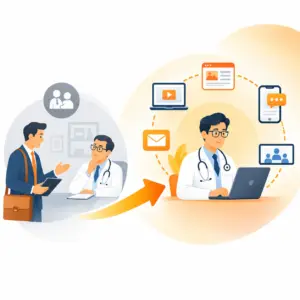
This creates a wider opportunity for HCP Marketing. Instead of expecting every important interaction to happen during a field visit, pharmaceutical brands can use multiple touchpoints to provide relevant information throughout the HCP journey. The question is not whether digital should replace the MR, but how digital and field engagement can make each other more effective.
From Visits to Continuous HCP Engagement
The biggest change in modern pharmaceutical marketing is the move from isolated interactions towards continuous engagement.
An MR visit may last a few minutes. A digital resource can remain accessible for weeks. A webinar can reach hundreds of HCPs. An email can provide follow-up information after a meeting. A scientific article can continue attracting relevant audiences long after publication.
This is where omnichannel pharma marketing becomes valuable.
An omnichannel approach allows a pharmaceutical brand to coordinate communication across field force, email, websites, webinars, digital content, conferences, and other relevant channels. Each channel has a different role, but the overall brand communication remains connected.
For example, an MR could introduce a clinical topic during a visit, direct the HCP towards an approved digital resource, and follow up with relevant educational content. The digital interaction then becomes an extension of the conversation rather than a separate marketing activity.
Personalisation Will Become More Important
More communication does not automatically mean better engagement.
HCPs receive a significant amount of professional information, which makes relevance increasingly important. A dermatologist, cardiologist, paediatrician, and general physician may have very different information needs even when they encounter the same pharmaceutical brand.
Future HCP Engagement will therefore need greater consideration of speciality, interests, previous interactions, preferred channels, and the stage of the relationship.
This does not mean sending a different message to every individual doctor. It means understanding audience segments well enough to make communication more useful.
A well-planned pharmaceutical marketing strategy can help define which audiences need what information, through which channel, and at which stage of the engagement journey.
The Role of Digital in Pharma Engagement
Pharma Digital Marketing has expanded the number of ways pharmaceutical brands can communicate with HCPs. Websites, professional content, webinars, email programmes, digital events, and educational resources can all contribute to the relationship.
The important consideration is that digital should have a purpose.
A digital campaign should not exist simply because a brand needs a digital campaign. It should answer a specific communication or engagement need.
For some audiences, a short scientific video may be more useful than a long article. For others, an expert webinar or downloadable resource may provide greater value. The right approach depends on the HCP, therapeutic area, objective, and stage of engagement.
This is where a pharma marketing agency can help connect channel planning with the larger brand strategy rather than treating digital activity as an isolated function.
 Pharma Branding Still Matters in a Digital-First Environment
As pharmaceutical brands increase their digital presence, brand consistency becomes even more important.
An HCP may see a brand through an MR, then encounter its website, receive an email, attend a webinar, and later see a campaign on another platform. If every interaction looks and sounds different, the brand can become difficult to recognise.
This makes pharma branding an important part of modern HCP engagement.
The brand proposition, visual identity, tone, scientific communication, and campaign territories should work together across touchpoints. A strong pharmaceutical brand strategy provides the foundation for that consistency.
The objective is not to make every interaction identical. It is to ensure that every interaction contributes to the same brand perception.
What Should Complement the Traditional MR Visit?
The answer is not a single new channel.
The future is more likely to involve a connected combination of field and digital interactions. The MR may remain central for relationship building and scientific discussion, while digital channels provide additional opportunities for education, follow-up, reminders, deeper content, and continued engagement.
A useful engagement ecosystem could include MR interactions for personal discussion and relationship building, digital content for continued education, webinars for expert-led learning, email for relevant follow-up, conferences for professional interaction, and online resources for on-demand information.
The exact combination will vary by brand and audience. What matters is that the channels work together.
 Pharmaceutical Campaigns Need to Become More Connected
Traditional campaigns often have a launch period, a set of promotional materials, and a defined communication cycle. Future pharma campaigns will increasingly need to function as ongoing ecosystems.
A campaign might begin with a scientific insight, continue through an HCP webinar, generate educational content, support MR conversations, and provide follow-up resources digitally.
This also changes the role of pharmaceutical advertising.
Advertising should not be viewed only as a way to create immediate awareness. It can introduce a brand proposition that is then reinforced through other forms of HCP communication.
The strongest campaigns create continuity. The HCP should be able to recognise the brand and understand its core proposition regardless of which touchpoint they encounter.
HCP Engagement and New Product Launches
This approach becomes particularly important during a pharmaceutical product launch.
A new product cannot depend entirely on a sales representative introducing it during individual visits. HCPs may already have questions about the category, mechanism, evidence, patient suitability, or clinical relevance before the first interaction with the field force.
Digital channels can help create awareness and provide educational context before, during, and after launch.
A strong pharmaceutical marketing strategy for new product launch can therefore combine field engagement with digital education, scientific content, expert interactions, webinars, and targeted communication.
The objective is to make the launch feel like an ongoing conversation rather than a single promotional event.
What Does This Mean for Pharma Marketers?
The future of HCP engagement requires pharmaceutical marketers to think beyond individual channels.
It means understanding the complete HCP journey and deciding where the brand can add value at different stages. It also means using data responsibly to understand engagement patterns, identifying which content is useful, and refining communication based on what audiences actually respond to.
For teams considering how to market pharmaceutical products, this shift is important. The answer increasingly involves a combination of scientific credibility, strong positioning, relevant content, digital experiences, field engagement, and consistent brand communication.
It also requires patience. HCP relationships are not built through one campaign or one digital interaction. They are built through repeated, relevant, credible experiences.
 Where Synapse Fits into the Future of HCP Engagement
For pharmaceutical companies, navigating this changing environment can be difficult because strategy, medical communication, creative development, technology, and execution all need to work together.
This is where the role of a specialised pharma marketing agency becomes more strategic.
At Synapse Marketing Consultancy, the focus is on connecting pharmaceutical marketing with the changing ways HCPs consume information and engage with brands. Whether the requirement involves pharmaceutical advertising, pharma branding, pharma campaigns, HCP engagement, digital initiatives, or a larger pharmaceutical marketing strategy, the objective is to create communication that works across the complete HCP journey.
The future of engagement is not about removing the MR from the equation. It is about giving the relationship more touchpoints, more relevance, and more continuity.
Frequently Asked Questions
Is the MR visit still relevant in modern pharmaceutical marketing?
Yes. The MR continues to play an important role in HCP relationships, particularly where personal interaction, scientific discussion, and relationship building are important. The change is that MR engagement can now be supported by digital and other channels rather than operating independently.
What is the role of omnichannel pharma marketing in HCP engagement?
Omnichannel pharma marketing connects field force, digital content, email, webinars, websites, conferences, and other relevant channels into a more consistent HCP journey. It helps brands provide relevant communication across multiple touchpoints instead of relying on a single interaction.
How can pharma digital marketing improve HCP engagement?
Pharma digital marketing can provide HCPs with convenient access to educational content, webinars, scientific information, digital resources, and follow-up communication. Its effectiveness depends on relevance, quality, timing, and how well it connects with the broader brand strategy.
How to market pharmaceutical products beyond traditional MR visits?
To understand how to market pharmaceutical products beyond traditional MR visits, brands can combine field engagement with digital content, webinars, professional education, email communication, conferences, online resources, and other relevant channels. The mix should be determined by the audience and communication objective.
What is the role of pharma branding in HCP engagement?
Pharma branding helps create recognition and consistency across different interactions. When the brand proposition, visual identity, and communication remain coherent across field and digital channels, HCPs are more likely to recognise and understand the brand over time.
What should a pharmaceutical marketing strategy for new product launch include?
A pharmaceutical marketing strategy for new product launch can include market understanding, HCP segmentation, positioning, scientific communication, field-force planning, digital engagement, educational initiatives, campaign development, and measurement. The exact approach depends on the therapeutic category and product objectives.
Why is HCP marketing becoming more personalised?
HCPs have different specialities, information needs, professional interests, and communication preferences. Greater personalisation allows pharmaceutical brands to make communication more relevant rather than sending the same message to every HCP.
What are important pharma branding best practices for HCP engagement?
Pharma branding best practices include having a clear brand proposition, maintaining consistent visual and verbal communication, understanding the HCP audience, connecting communication across channels, and ensuring that brand messaging remains credible and relevant.
How can a pharma marketing agency support HCP engagement?
A specialised pharma marketing agency can help develop the brand strategy, identify relevant HCP audiences, plan omnichannel communication, create campaigns, develop digital initiatives, and connect field and digital engagement into a consistent experience.
What should brands look for in the best pharma marketing agency in India?
When evaluating the best pharma marketing agency in India, pharmaceutical companies can consider the agency’s understanding of healthcare and HCP audiences, strategic capabilities, creative strength, digital expertise, experience across therapeutic categories, and ability to connect multiple communication channels into a coherent brand strategy.
Conclusion
The future of HCP engagement is not about choosing between the MR and digital communication. It is about understanding that HCP relationships now extend across a much wider ecosystem of interactions.
MR can remain an important part of that ecosystem, while digital content, webinars, professional education, email, online resources, and other channels create additional opportunities to inform and engage. When these touchpoints are connected by a clear pharmaceutical brand strategy, every interaction can contribute to stronger brand recognition and a more meaningful HCP relationship.
For pharmaceutical companies, the opportunity is to move from a model built around individual visits to one built around continuous, relevant engagement.
And that is where the next generation of pharmaceutical marketing will be shaped: not by replacing traditional engagement, but by making every interaction work harder, work smarter, and add something meaningful to the relationship.