Quick Answer
Generative AI creates content, ideas, summaries, images, responses, and other outputs based on the instructions it receives. Agentic AI goes a step further by using AI to plan and carry out a sequence of tasks towards a defined objective, often with limited human intervention. For healthcare marketers, the difference matters. Generative AI can accelerate content and communication, while agentic systems can help connect research, planning, execution, personalisation, and automation. The opportunity lies in knowing where each technology fits into the healthcare marketing workflow.
Key Takeaways
- Generative AI and Agentic AI solve different problems and should not be treated as interchangeable.
- Generative AI is particularly useful for content creation, ideation, summarisation, and communication support.
- Agentic AI can coordinate multiple tasks and workflows towards a defined marketing objective.
- Healthcare marketers need stronger oversight because healthcare communication involves accuracy, privacy, compliance, and trust.
- AI can support patient engagement and HCP engagement, but it should not replace appropriate medical or human judgement.
- The most useful applications will solve specific marketing problems rather than simply adding AI to existing processes.
- Healthcare brands should prepare for AI-enabled marketing while keeping strategy and accountability human-led.
 What Is the Difference Between Generative AI and Agentic AI?
Artificial intelligence has moved quickly from a topic discussed by technology teams to a part of everyday marketing conversations.
Healthcare marketers are now exploring AI for content development, audience engagement, research, personalisation, automation, and even customer support. But as the technology evolves, new terminology can make the landscape more confusing.
Two terms appearing increasingly often are Generative AI and Agentic AI.
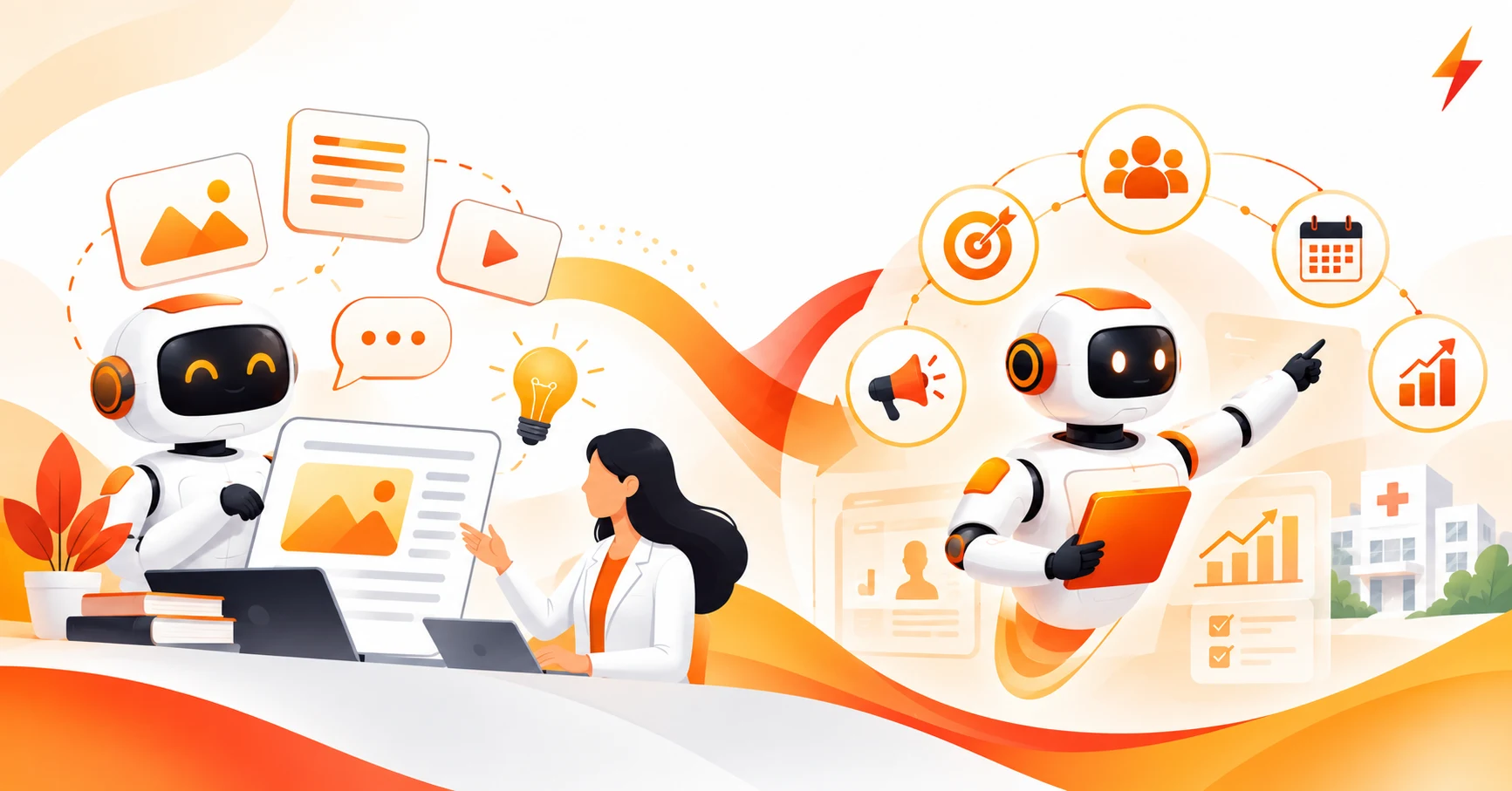
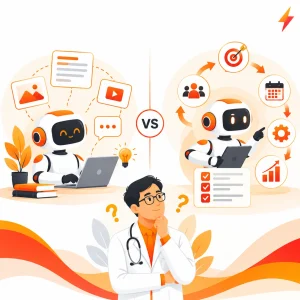
Generative AI is designed to create. Give it a prompt, and it can generate a blog, summarise a research paper, suggest campaign concepts, draft an email, create an image, or help develop variations of communication.
Agentic AI is more focused on action. Instead of simply responding to one instruction, an agentic system can potentially break a larger objective into steps, use connected tools or information sources, make decisions within defined boundaries, and complete a workflow.
For healthcare marketing, the difference can be understood simply: Generative AI can help create the work. Agentic AI can potentially help manage and execute parts of the work.
That distinction is important because the marketing opportunity is different for each.
Where Generative AI Fits Into Healthcare Marketing
Generative AI has already changed how marketers approach content and creative development.
In healthcare, its applications can range from drafting educational content and creating communication variations to summarising information, developing campaign territories, preparing briefs, and adapting content for different audiences.
This is where generative AI in healthcare becomes particularly relevant.
A healthcare marketer working on a disease awareness campaign, for example, may need multiple versions of educational communication for different digital channels. Generative AI can help create initial drafts or variations based on an approved strategy and source material.
It can also help teams move faster during the early stages of ideation.
However, speed should not be confused with accuracy.
Healthcare content requires a higher level of scrutiny than many consumer categories. A generated piece of AI medical content still needs appropriate human review, fact-checking, medical validation where required, and compliance checks before it reaches an audience.
AI can accelerate the process. It does not remove the responsibility.
What Is Agentic AI?
The easiest way to understand Agentic AI is to compare it with a conventional chatbot.
A chatbot typically responds when a user asks something.
An agentic system can potentially be given a broader objective and determine the steps required to work towards it.
For example, instead of asking an AI to write five social media posts, a marketer could potentially ask an AI-enabled workflow to identify relevant content topics, review a defined knowledge base, develop draft communication, adapt it for different channels, organise the outputs, and flag items that require human approval.
The exact capabilities depend on the system, its integrations, permissions, and level of autonomy.
This makes Agentic AI particularly interesting for repetitive and multi-step marketing workflows.
It does not necessarily mean handing the entire marketing function over to an autonomous system. In healthcare, that would introduce obvious concerns around accuracy, compliance, privacy, brand governance, and accountability.
A more practical approach is to use agentic systems within clearly defined boundaries.
Generative AI vs Agentic AI: Which One Does a Healthcare Marketer Need?
The answer is not necessarily one or the other.
They can serve different layers of the same marketing ecosystem.
Generative AI is useful when the challenge is producing or transforming information. Agentic AI becomes more relevant when the challenge involves coordinating multiple actions.
Consider a healthcare campaign.
Generative AI could help a team brainstorm campaign directions, draft content, summarise research, create audience-specific variations, or convert approved information into different formats.
An agentic system could potentially take a larger workflow and coordinate activities such as gathering information from approved sources, preparing content variations, routing them for review, organising campaign assets, monitoring defined metrics, and triggering certain predefined actions.
The first is primarily about generation.
The second is about orchestration and action.
That difference is likely to become increasingly important as healthcare marketing teams explore AI.
AI in Healthcare Marketing Is Moving Beyond Content Creation
Much of the early conversation around AI in healthcare marketing focused on content generation.
That makes sense. Content is one of the most visible areas where AI can save time.
But marketing involves much more than content.
There is audience research, segmentation, campaign planning, lead management, website engagement, customer support, analytics, HCP communication, patient education, and follow-up.
AI can potentially influence each of these areas.
The important question for healthcare organisations is therefore not “Where can we use AI?” but “Which marketing problems can AI solve better or faster without compromising quality and trust?”
That shift in thinking can prevent brands from adopting AI simply because it is fashionable.
 Healthcare AI Chatbots and Patient Engagement
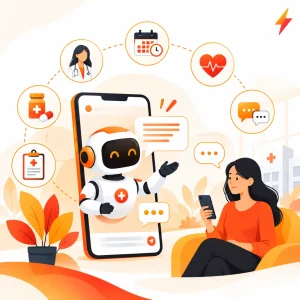
One of the more visible applications is the healthcare AI chatbot.
Healthcare chatbots can help users find information, navigate services, answer predefined questions, support education, or guide people towards relevant resources. When appropriately designed, they can provide an accessible digital touchpoint outside traditional working hours.
This makes AI particularly relevant to patient engagement.
For example, an AI-enabled healthcare assistant could help a visitor understand available services on a healthcare website, locate relevant educational information, or navigate frequently asked questions.
However, healthcare chatbots need clear boundaries.
They should not create an impression that an AI system is a substitute for a qualified healthcare professional. Their scope, knowledge sources, escalation mechanisms, privacy safeguards, and communication should be carefully considered.
This is also why the idea of an AI assistant for healthcare websites needs to be approached as a user experience and governance challenge, not simply a technology project.
AI for Patient Education
Healthcare communication has always had an educational responsibility.
Patients often encounter complicated medical information online and may struggle to understand terminology, treatment pathways, or basic health concepts.
This creates an opportunity for AI for patient education.
AI can help present information in different formats and levels of complexity, answer common questions, or guide users towards relevant resources. It can potentially make large libraries of approved information easier to navigate.
But there is a critical distinction between making information easier to understand and generating medical advice without appropriate safeguards.
The source material matters.
The review process matters.
The context matters.
And the limits of what the system should answer matter.
For healthcare marketers, responsible AI adoption therefore needs to include governance alongside innovation.
AI for Pharma Marketing
The pharmaceutical industry presents an especially interesting use case.
AI for pharma marketing can support activities across research, content development, audience segmentation, campaign planning, HCP communication, analytics, and automation.
A pharma marketing team could potentially use AI to analyse large volumes of existing content, identify frequently discussed themes, develop initial content structures, or adapt approved communication for different channels.
There is also growing interest in AI doctor engagement.
HCPs interact with brands through multiple touchpoints, and AI can potentially help organisations make those interactions more relevant by using approved data and content to support personalisation.
But personalisation should not become unnecessary intrusion.
The value of AI in HCP engagement will depend on whether it makes communication more relevant and useful rather than simply more frequent.
AI and Medical Affairs
The potential applications extend beyond marketing.
AI for medical affairs is another important area because medical affairs teams work with large volumes of scientific information, publications, medical queries, evidence, and communication.
AI can assist with information organisation, summarisation, literature-related workflows, content preparation, and other structured tasks, subject to appropriate validation and oversight.
This is particularly relevant because medical and commercial teams increasingly need to work with large and complex information environments.
The opportunity is not to automate medical judgement. It is to reduce repetitive work around information management so that professionals can spend more time on activities that require expertise and judgement.
Healthcare Marketing Automation Using AI
Marketing automation has already changed how brands manage repetitive communication.
Adding AI to that ecosystem can make workflows more adaptive.
Healthcare marketing automation using AI could potentially help identify audience behaviour, personalise communication, prioritise leads, recommend content, or trigger predefined follow-up workflows.
This can be particularly useful when organisations are managing large audiences and multiple communication channels.
For example, a healthcare organisation may have different audiences interacting with different services. AI-enabled automation can potentially help organise these journeys so that communication is more relevant to the person’s previous interaction.
But automation should not mean communication without oversight.
Healthcare brands need to establish rules around what can be automated, what requires human approval, what information can be used, and when a conversation should be transferred to a person.
 AI Healthcare Communications Need a Human Layer
There is a temptation to assume that better AI automatically means better communication.
It does not.
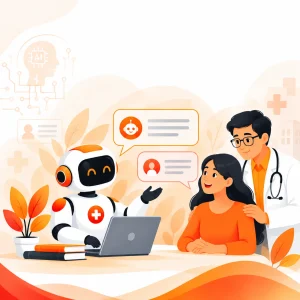
AI healthcare communications still need strategy, context, empathy, creativity, medical accuracy, and brand understanding. A machine may be able to produce ten versions of a message in seconds. That does not mean all ten are strategically relevant. Healthcare communication often deals with sensitive subjects. The way something is communicated can matter as much as the information itself. That is why human involvement remains essential.
- AI can provide scale.
- People provide judgement.
- AI can identify patterns.
- People decide what those patterns mean for the brand.
- AI can generate possibilities.
- People decide which possibility deserves to become communication.
- That relationship is likely to define successful AI adoption in healthcare marketing.
How AI Is Transforming Healthcare Marketing
So, how AI is transforming healthcare marketing is not really a question about whether marketers will be replaced. It is a question about how the nature of marketing work will change. Some repetitive activities will become faster. Research and information processing may become more efficient. Personalisation may become easier to manage at scale. Content production may require fewer manual steps. Data may become more actionable. This gives marketing teams more time to focus on strategy, creative thinking, audience understanding, brand building, and decision-making. The advantage will not necessarily belong to organisations that use the most AI tools. It may belong to those that know where AI genuinely adds value.
What Healthcare Marketers Should Not Automate Blindly
AI adoption in healthcare needs boundaries.
Content that makes clinical claims, patient-facing medical information, HCP communication, personal data, and regulated promotional material may require significantly greater oversight than routine administrative tasks. Healthcare brands should therefore establish clear governance before expanding AI usage. A useful starting point is to classify activities according to their level of risk and human involvement.
Low-risk activities such as brainstorming, formatting, summarisation of approved material, and internal workflow support may offer relatively straightforward opportunities. Higher-risk activities involving medical interpretation, patient-specific information, clinical claims, or external communication require stronger controls and appropriate expert review.
The point is not to slow innovation. It is to make innovation sustainable.
AI Healthcare Marketing Examples: Where to Start
There are already several practical areas where healthcare organisations can explore AI without trying to automate everything at once. A healthcare brand could use generative AI to create first drafts from approved source material, support content repurposing, summarise internal information, or assist creative teams during ideation. A hospital could explore an AI assistant for website navigation and frequently asked questions. A pharma organisation could investigate AI-supported HCP engagement workflows or content personalisation. A marketing team could use AI-enabled automation to organise leads and trigger appropriate follow-up communication.
These AI healthcare marketing examples share one characteristic: they solve a specific problem. That is a better starting point than adopting AI simply because competitors are discussing it.
 Building an AI-Ready Healthcare Marketing Strategy
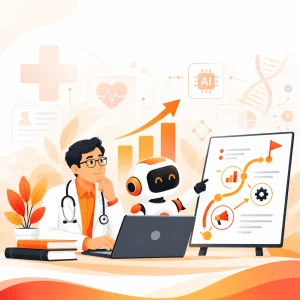
AI should not sit separately from the overall marketing strategy. Before adopting a tool or workflow, healthcare organisations should understand what they are trying to improve.
Is the problem content volume?
Is it slow response time?
Is it fragmented data?
Is it repetitive communication?
Is it poor personalisation?
Is it difficult to manage large-scale HCP engagement?
Once the problem is clear, the appropriate technology becomes easier to identify. This is also where the broader AI in pharmaceutical marketing strategy conversation becomes important. AI should support the commercial and communication objectives of the brand rather than becoming the objective itself. The same principle applies across hospitals, pharma companies, diagnostics brands, healthtech businesses, and other healthcare organisations.
Where Synapse Fits Into the AI Conversation
For healthcare brands, technology works best when it is connected to a strong understanding of the audience, brand, communication challenge, and business objective.
At Synapse Marketing Consultancy, we see AI as an enabler within that larger ecosystem. It can help healthcare brands explore new ways of creating content, engaging audiences, managing digital journeys, and improving marketing efficiency, but the strategy behind those applications remains critical.
The role of a healthcare marketing partner is therefore evolving. It is no longer only about creating campaigns. It is also about understanding where new technologies can make those campaigns more relevant, scalable, measurable, and useful. That requires bringing together healthcare knowledge, marketing strategy, creative thinking, digital capabilities, and responsible use of AI.
Frequently Asked Questions
What is the difference between Generative AI and Agentic AI in healthcare marketing?
Generative AI primarily creates content and outputs based on instructions, while Agentic AI is designed to work towards broader objectives by planning and coordinating multiple steps. Healthcare marketers can use the former for content and ideation and explore the latter for more complex marketing workflows.
How is AI transforming healthcare marketing?
AI is transforming healthcare marketing by supporting content creation, personalisation, patient engagement, HCP engagement, marketing automation, research, analytics, and digital experiences. Its impact is likely to increase as organisations connect AI with their existing marketing systems and workflows.
What is a Healthcare AI Chatbot?
A Healthcare AI Chatbot is an AI-powered conversational interface that can help users access information, navigate healthcare services, answer defined questions, or find relevant resources. Its scope and safeguards should be clearly defined, particularly when communicating with patients.
What is the best AI chatbot for healthcare websites?
The best AI chatbot for healthcare websites depends on the organisation’s objectives, audience, information sources, integrations, privacy requirements, escalation processes, and governance framework. Healthcare brands should evaluate these factors rather than choosing a chatbot based solely on its general AI capabilities.
How can AI be used for patient education?
AI can support patient education by making approved healthcare information easier to search, understand, personalise, and navigate. It can also help users find relevant educational resources while maintaining appropriate boundaries around medical advice.
How can AI be used for pharmaceutical marketing?
AI can support pharmaceutical marketing through content development, audience analysis, HCP engagement, personalisation, workflow automation, research support, and campaign optimisation. Human oversight remains important for medical accuracy, compliance, and strategic decision-making.
What is AI in Pharmaceutical Marketing Strategy?
AI in Pharmaceutical Marketing Strategy refers to using AI capabilities as part of broader pharma marketing planning to improve activities such as audience understanding, content, HCP engagement, personalisation, automation, and measurement. The technology should support the brand strategy rather than replace it.
Can AI improve HCP engagement?
AI can potentially improve HCP engagement by helping organisations deliver more relevant information, personalise communication, organise interaction data, and support timely follow-ups. Its effectiveness depends on the quality of the data, content, strategy, and governance behind the system.
What is AI for Medical Affairs?
AI for Medical Affairs refers to the application of artificial intelligence to activities such as information management, scientific content workflows, literature-related tasks, medical queries, and other structured processes. Appropriate expert validation remains essential.
How should healthcare brands approach AI adoption?
Healthcare brands should begin with clearly defined business or communication problems, identify suitable AI applications, establish governance, and introduce human review where required. Starting with specific use cases is generally more useful than trying to automate an entire marketing function.
Conclusion
The conversation around AI in healthcare marketing is moving from experimentation towards practical application. Generative AI has already demonstrated how quickly machines can help create and transform information. Agentic AI introduces another possibility: systems that can coordinate multiple steps and complete defined workflows with greater autonomy.
For healthcare marketers, the opportunity lies somewhere between these two capabilities. The brands that benefit from AI will not necessarily be those that automate the most. They will be the ones that understand where technology can genuinely improve the experience for patients, HCPs, marketing teams, and the organisation itself.
AI can create faster. It can process more information. It can automate repetitive work. But healthcare brands still need people to provide strategy, judgement, accountability, empathy, and context.
At Synapse Marketing Consultancy, we believe the future of healthcare marketing will be shaped not by AI replacing human expertise, but by the two working together intelligently. From AI-powered content and patient engagement to healthcare chatbots, HCP communication, automation, and digital experiences, the real value comes from applying technology to the right problem with the right strategy behind it.