

A memorable healthcare brand is built on more than a strong logo or a successful advertising campaign. It starts with a clear purpose, a distinct position, consistent communication, and a patient experience that delivers on the brand promise. Effective healthcare branding brings these elements together with a focused healthcare marketing strategy, helping hospitals, pharma companies, diagnostics brands, and healthcare organisations build trust, recognition, and long-term patient relationships.
Key Takeaways
- Healthcare branding is about shaping trust and perception, not just visual identity.
- Strong positioning helps a healthcare brand stand apart in a crowded market.
- Patient understanding should come before communication and promotion.
- Consistency across digital and offline touchpoints strengthens brand recall.
- Educational content can build authority while supporting organic visibility.
- Patient experience is one of the strongest drivers of healthcare brand perception.
- Branding should be measured and refined continuously, not treated as a one-time exercise.
Introduction
Think about a healthcare brand you would confidently recommend to someone. Chances are, you remember it for more than its logo or an advertisement. You remember the experience, the expertise, the communication, or simply the sense that you could trust it when it mattered.
That is the real power of healthcare branding.
Healthcare has become increasingly competitive. Hospitals are competing for patients, pharmaceutical companies are competing for attention among healthcare professionals, diagnostics brands are expanding their digital presence, and healthcare startups are entering categories that were once dominated by established players. At the same time, patients are more informed than ever. They search online, compare providers, read reviews, consume health content, and often form an opinion about a brand before making direct contact.
This has changed the role of healthcare marketing. Visibility is important, but visibility alone does not create preference. A healthcare organisation can run campaigns across multiple platforms and still struggle to become memorable if there is no clear idea behind the communication.
A strong healthcare brand gives every marketing activity a common direction. It defines what the organisation stands for, who it wants to serve, how it is different, and what people should remember about it.
That is why branding needs to come before promotion. Before asking people to choose your brand, you need to give them a reason to remember it.
What Is Healthcare Branding?
Healthcare branding is the process of defining and shaping how a healthcare organisation is perceived by its audiences. It goes well beyond a logo, colour palette, tagline, or advertising campaign.
A healthcare brand is built through every interaction a person has with an organisation. A patient’s Google search, a hospital website, a doctor’s consultation, a social media post, a patient review, an appointment experience, or even a follow-up message can influence how that brand is perceived.
This makes healthcare branding closely connected to healthcare marketing, but the two are not the same.
Branding defines who you are and what you stand for. Marketing communicates that value to the right audience. Advertising amplifies that communication through paid channels.
A strong healthcare marketing strategy needs all three to work together. Without a clear brand foundation, marketing can become a series of disconnected campaigns that generate attention without creating lasting recall.
For healthcare organisations, that distinction is particularly important because trust plays such a significant role in decision-making. Patients are not simply choosing a product or service. They are often choosing who they believe can help them during an important or vulnerable moment in their lives.
 Why Healthcare Branding Matters More Than Ever
The healthcare decision journey has changed dramatically. A patient may discover a hospital through search, compare doctors through online profiles, read reviews, watch educational videos, and explore treatment information before ever making an appointment.
This means your brand is being evaluated long before your sales or marketing team gets an opportunity to speak to the person.
Digital transformation has also made healthcare markets more crowded. Having a good facility, experienced doctors, advanced technology, or quality products is important, but these factors alone may not differentiate a brand because competitors can make similar claims.
Branding provides the opportunity to build a more distinctive identity.
A clear brand position can answer questions such as:
- What does this organisation stand for?
- Who is it best suited for?
- What makes it different?
- Why should people trust it?
- What should people remember after interacting with it?
When these answers are clear, healthcare campaigns become more focused. Content becomes more consistent. Digital communication becomes easier to recognise. Most importantly, audiences begin to associate the brand with a specific promise rather than a collection of unrelated messages.
For a healthcare marketing agency, this is often the starting point of effective brand building. Before deciding what campaign to create, it is important to understand what the brand should own in the minds of its audience.
The 7 Pillars of a Healthcare Brand Patients Remember
Building a memorable brand does not happen through one campaign. It happens when several elements consistently work together.
 1. Start With a Clear Purpose
Every strong healthcare brand needs a reason to exist beyond simply selling a service or product.
A hospital may want to make specialised care more accessible. A pharmaceutical company may focus on improving outcomes in a particular therapeutic area. A diagnostics brand may build its identity around accuracy and preventive healthcare.
The purpose does not need to be complicated. It needs to be genuine and relevant.
Once defined, that purpose can guide the brand’s positioning, messaging, content, campaigns, and patient experience. It gives the organisation a consistent idea to build around instead of changing its message with every new campaign.
2. Understand Your Audience
Healthcare communication becomes stronger when it begins with understanding rather than assumption.
Patients, caregivers, doctors, healthcare professionals, and other stakeholders have different questions and motivations. A patient may want simple explanations and reassurance, while an HCP may need scientific evidence and clinical depth.
Understanding these differences helps brands create communication that feels useful rather than generic.
Before building a healthcare brand, organisations should understand what their audiences search for, what concerns them, what influences their decisions, and where they seek information.
The better the understanding, the more relevant the communication.
3. Own a Clear Position
- Many healthcare brands sound identical.
- “Patient-centric care.”
- “Advanced technology.”
- “Experienced doctors.”
- “World-class facilities.”
- These statements may be true, but they do little to create differentiation when every competitor says the same thing.
- A strong healthcare brand strategy identifies a position that is meaningful to the audience and credible for the organisation to own.
The question is simple:
- Why should someone remember your brand instead of another brand offering something similar?
– The answer becomes the foundation for communication across campaigns, content, digital platforms, and patient experiences.
4. Make Every Touchpoint Consistent
A patient does not experience your brand through one advertisement.
They may discover you through Google, visit your website, see a social media post, read a review, speak to a representative, visit a facility, interact with staff, and receive follow-up communication.
Every one of these interactions contributes to brand perception.
Consistency does not mean saying exactly the same thing everywhere. It means making sure that the same brand values, personality, promise, and quality of experience are reflected across channels.
This includes:
- Website and landing pages
- Social media
- Patient education material
- Email and messaging
- In-clinic communication
- Events and conferences
- Doctor engagement
- Customer support
When these experiences feel connected, the brand becomes easier to recognise and trust.
5. Educate Before You Promote
Healthcare decisions require information. This makes education one of the most effective ways to build authority and trust.
Instead of constantly telling people what a brand offers, healthcare organisations can create content that answers the questions people are already asking.
This could include blogs, videos, doctor interviews, webinars, patient guides, disease awareness campaigns, and educational social media content.
The approach has another advantage. Useful content can improve organic search visibility by answering relevant questions and attracting people at different stages of the patient journey.
A healthcare brand that consistently helps people understand their health can become a trusted source of information, not just another advertiser.
6. Build the Patient Experience Around the Promise
A brand promise means little if the actual experience does not support it.
If a healthcare organisation positions itself around compassionate care, patients should experience that compassion. If it promises convenience, the booking and communication journey should reflect it. If it positions itself around expertise, its content and interactions should demonstrate that expertise.
This alignment between what a brand says and what people experience is critical to trust.
Patient engagement therefore needs to extend beyond campaigns. It should include communication, accessibility, responsiveness, feedback, education, and support throughout the patient journey.
7. Measure and Refine
Healthcare branding is a long-term process, but that does not mean it cannot be measured.
Alongside campaign metrics such as traffic, engagement, and conversions, organisations should look at indicators that reflect brand strength.
These can include:
- Brand recall
- Patient satisfaction
- Search visibility
- Online reputation
- Referral behaviour
- Repeat engagement
- HCP engagement
- Patient inquiries
The objective is not to chase every metric. It is to understand whether the brand is becoming more recognisable, trusted, and relevant over time.
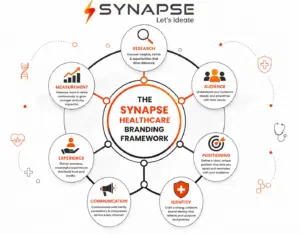 The Synapse Healthcare Branding Framework
A strong brand needs a structured approach. At Synapse, we see healthcare brand building as a connected process rather than a collection of independent marketing activities.
Research → Audience → Positioning → Identity → Communication → Experience → Measurement
It starts with research. Understanding the category, competition, audience behaviour, and market environment helps identify where the brand can create meaningful differentiation.
Audience understanding follows. Once we know who we are speaking to and what they need, we can shape a more relevant brand proposition.
Positioning then defines what the brand should own. This becomes the foundation for its identity, messaging, tone, and communication.
The next stage is execution. This is where healthcare marketing services, content, SEO, digital campaigns, social media, medical communication, and other channels come together.
Finally, measurement tells us what is working and what needs to evolve.
The framework may look straightforward, but its value lies in ensuring that every marketing decision connects back to the same strategic foundation.
Common Healthcare Branding Mistakes
Even strong healthcare organisations can weaken their brand by making a few fundamental mistakes.
- Promoting before positioning: Running campaigns without defining what the brand should stand for often leads to inconsistent communication.
- Trying to say everything: A brand that communicates every feature, service, achievement, and capability may end up being remembered for nothing specific.
- Copying competitors: Healthcare brands often use similar visual styles and messaging. Differentiation requires finding a space that is genuinely ownable.
- Ignoring the patient journey: Advertising may create a strong first impression, but a poor website, difficult booking process, or inconsistent service can quickly damage trust.
- Measuring only campaign performance: Clicks and impressions matter, but brand recall, reputation, engagement, and patient trust matter too.
 The Future of Healthcare Branding
The next phase of healthcare branding will be shaped by technology, changing search behaviour, and increasingly informed audiences.
Artificial intelligence is changing how people discover information. Healthcare brands will need content that is not only optimised for traditional search engines but also structured to be understood by AI-powered search and answer platforms.
This makes Answer Engine Optimization (AEO) and Generative Engine Optimization (GEO) increasingly relevant to healthcare marketing.
Personalisation will also become more important. Patients expect communication that is relevant to their needs rather than generic messages sent to everyone.
At the same time, technology will not replace the fundamentals of branding. Trust, clarity, credibility, consistency, and patient experience will continue to determine which healthcare brands people remember.
The channels may change.
The way people search may change.
But the need for trust will not.
Frequently Asked Questions
- What is healthcare branding?
Healthcare branding is the process of defining and shaping how a healthcare organisation is perceived by patients, HCPs, caregivers, and other stakeholders. - Why is healthcare branding important?
It helps healthcare organisations build trust, create differentiation, improve recall, and establish stronger relationships with their audiences. - How is healthcare branding different from healthcare marketing?
Branding defines what an organisation stands for and how it should be perceived. Marketing communicates that positioning to the right audience through appropriate channels. - What makes a healthcare brand memorable?
Clear positioning, consistent communication, meaningful patient experiences, educational content, and a strong sense of purpose all contribute to brand recall. - Can a healthcare marketing agency help with branding?
Yes. A specialised agency can help develop positioning, brand strategy, communication frameworks, content, campaigns, digital visibility, and patient engagement initiatives.
Conclusion
A healthcare brand does not become memorable because it advertises more. It becomes memorable because people understand what it stands for and experience that promise consistently.
The strongest healthcare brands start with purpose, understand their audiences, establish clear positioning, and build every marketing activity around that foundation. They educate before they promote, create meaningful patient experiences, and continuously learn from data and audience behaviour.
In an increasingly competitive healthcare market, branding is no longer a nice-to-have. It is what helps organisations move from being visible to being considered, trusted, and remembered.
If you are looking to build a healthcare brand with a clear strategy, distinctive positioning, and communication that connects with the right audience, Synapse Marketing Consultancy can help. With nearly two decades of experience as a healthcare marketing and advertising partner in Mumbai, Synapse brings together strategy, branding, medical communication, digital marketing, and creative thinking to help healthcare brands build lasting relevance.
Because ultimately, the goal is not simply to make people notice your brand.
It is to make them remember why it matters.